What Substack Is (And Where People Get It Wrong)
Most professionals are producing more content than ever.
LinkedIn posts. Emails. Occasional videos or podcasts.
The volume is there.
The results are inconsistent.
Not because the content is poor, but because it is scattered.
There is no central place where ideas compound, relationships deepen, and offers connect.
That is the gap Substack is quietly filling.
What Substack Actually Is
Substack is a direct-to-audience publishing platform with built-in distribution and monetization.
It combines:
- Long-form publishing
- Email delivery
- Subscription and payment infrastructure
- A built-in discovery network
Every time you publish, your content becomes:
- An article
- An email to your subscribers
- A piece of content that can circulate within the platform
That combination is what makes it strategically valuable.
This is not just a place to write.
It is a place to build an audience you can reach and monetize without relying entirely on third-party platforms.
What Substack Is Not
Substack is often described as “not social media” or “algorithm-free.”
That is no longer accurate.
Substack is a hybrid system with two distinct layers.
1. Direct Delivery Layer
When someone subscribes, your content is sent directly to their inbox.
No feed ranking determines whether it is delivered.
This is the closest thing to owned reach available today.
But delivery is not the same as attention.
Open rates, subject lines, and relevance still matter.
2. Network and Discovery Layer
Substack now includes:
- Notes (short-form feed)
- Recommendations between publications
- Trending and suggested posts
- Built-in growth loops between creators
These features are driven by engagement and behavior.
There is still an algorithm.
It simply operates differently than traditional platforms.
Why This Distinction Matters
Substack does not remove algorithms.
It reduces your dependence on them.
That distinction is what makes it powerful.
The Two Roles Substack Plays in Your Business
Understanding Substack becomes easier when you separate its two functions.
Owned Audience
Your subscriber list.
Your direct line of communication.
This is where trust and authority are built over time.
Network Growth
The discovery layer.
This is where new people find your work through:
- Notes
- Recommendations
- Shared audiences
Used intentionally, this accelerates growth.
Ignored, growth slows.
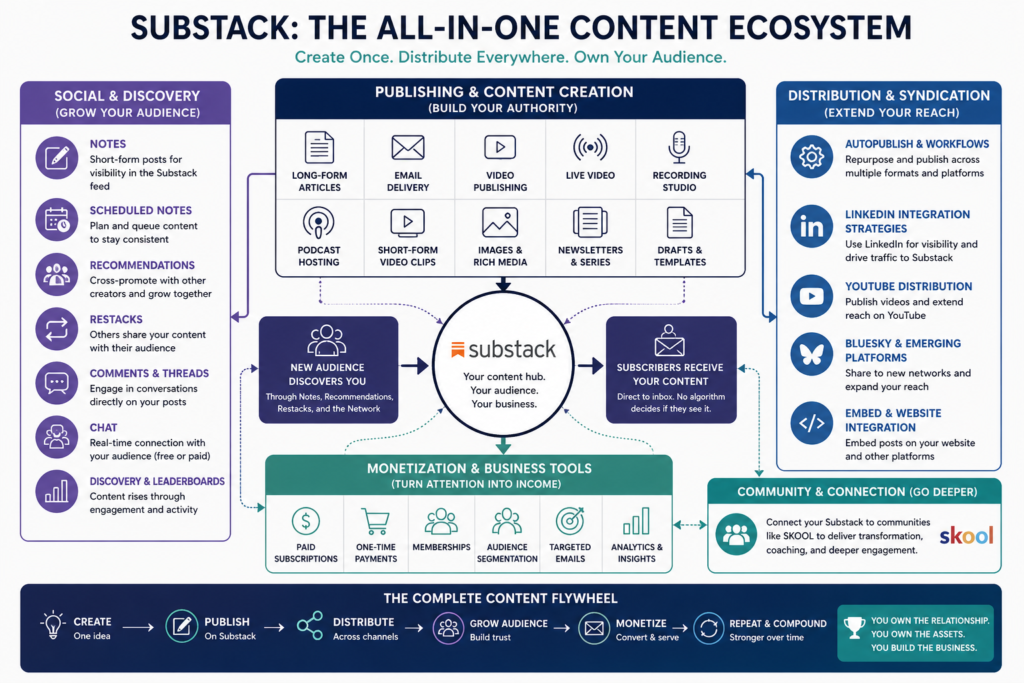
Substack Features (What You Can Actually Do)
Substack has evolved beyond a simple writing platform.
It now functions as a full content ecosystem.
Social and Discovery Features
These tools help your content get seen:
- Notes for short-form visibility
- Scheduled Notes for consistency
- Recommendations for audience growth
- Restacks for sharing
- Comments and threads for engagement
- Chat for real-time interaction
- Discovery feeds and leaderboards
Publishing and Content Creation Features
This is where Substack becomes your content hub:
- Long-form articles
- Email delivery with every post
- Video publishing
- Live streaming
- Built-in recording studio
- Podcast hosting (distributed to Spotify and Apple)
- Short-form clips
- Images and rich media
- Paid subscriptions
- Audience segmentation
How Substack Replaces Multiple Tools
Most people are trying to manage five or six platforms separately.
Substack allows you to centralize creation and distribute outward.
Instead of creating more content, you create structured content that moves.
Why Substack Works for Monetization
Revenue is no longer tied to audience size alone.
It is tied to alignment and relationship strength.
Monetization can happen through:
- Paid subscriptions
- Direct offers
- Coaching or services
- Partnerships and sponsorships
Because content is delivered via email, engagement is more intentional.
Readers are choosing to read, not scrolling past.
That difference changes conversion behavior.
The Role of LinkedIn
LinkedIn is one of the strongest visibility platforms available.
It provides:
- A built-in audience
- Professional credibility
- Consistent reach
But you do not control distribution.
Visibility fluctuates.
Substack complements this by turning attention into connection.
A simple structure:
- Use LinkedIn to share insights
- Direct people to deeper content
- Convert readers into subscribers
Over time, this shifts your audience from rented attention to owned connection.
Where Community Fits In
Content builds authority.
Email builds relationship.
Community builds depth.
Platforms like Skool support:
- Structured learning
- Ongoing engagement
- Accountability
- Peer interaction
Together, the system becomes clear:
- LinkedIn → visibility
- Substack → content hub and audience ownership
- Community → engagement and transformation
How Content Becomes a Long-Term Asset
Content fatigue usually comes from lack of structure.
A better approach:
One idea becomes multiple assets:
- A Substack article
- An email
- Several LinkedIn posts
- A podcast or video
- Short-form content
Substack becomes the central hub.
Everything else amplifies it.
Over time, your content compounds instead of disappearing.
Substack Isn’t a Replacement
The Platform is not a replacement for LinkedIn.
It is an extension of it.
LinkedIn creates visibility.
Substack builds relationships and revenue.
Community deepens engagement.
When used together, content becomes purposeful instead of scattered.
Need Help?
Want help turning your content into a simple system that actually brings in clients?
👉 Or schedule a Client Acquisition Audit and get clear on your next step

